Latest micro-posts
You can also also view the full archives of micro-posts. Longer blog posts are available in the Articles section.
/me is listening to “The Passenger” by Iggy Pop
Vista looks like a good replacement for Feh on macOS. And it’s free on the AppStore. #apple
Making git hooks visible: I don’t have that many Git hooks for my own repos but this looks like a good idea. I’m already using a Zsh hook to detect uv virtual environments:
function auto_activate_venv() {
  if [ -f ".venv/bin/activate" ]; then
    source .venv/bin/activate
  fi
}

autoload -U add-zsh-hook
add-zsh-hook chpwd auto_activate_venv
I found myself spending most of my time in a Wolfram notebook these days. For whatever reason, the builtin LSP has stopped working with BBEdit (maybe because I moved my user files to iCloud, or for whatever reasons I don’t really care at the present time) and code formatting (via CodeFormatter) is now a mess. I mean, it just hurts my eyes to find comma on a single line, like this: (indentation preserved)
-%<---
        Epilog ->
          {
            {Red, Dashed, Line[{{1, threshold}, {Max[1, Length[kappa]
              ], threshold}}]}
            ,
            {Red, Dashed, Line[{{1, -threshold}, {Max[1, Length[kappa
              ]], -threshold}}]}
            ,
            Table[
              {
                Purple
                ,
                Thick
                ,
                Line[
                  {{pos, Min[kappa, 0]}, {pos, Max[kappa, 0]}} /.
                    {
--->%-
I’ve tried various combination of Airiness and other options (but see this GH issue) but never got something decent although it was working fine with v14. I’ve disabled auto-formatting in Neovim. Copying/pasting a whole notebook to a plain text file provides decent formatting.
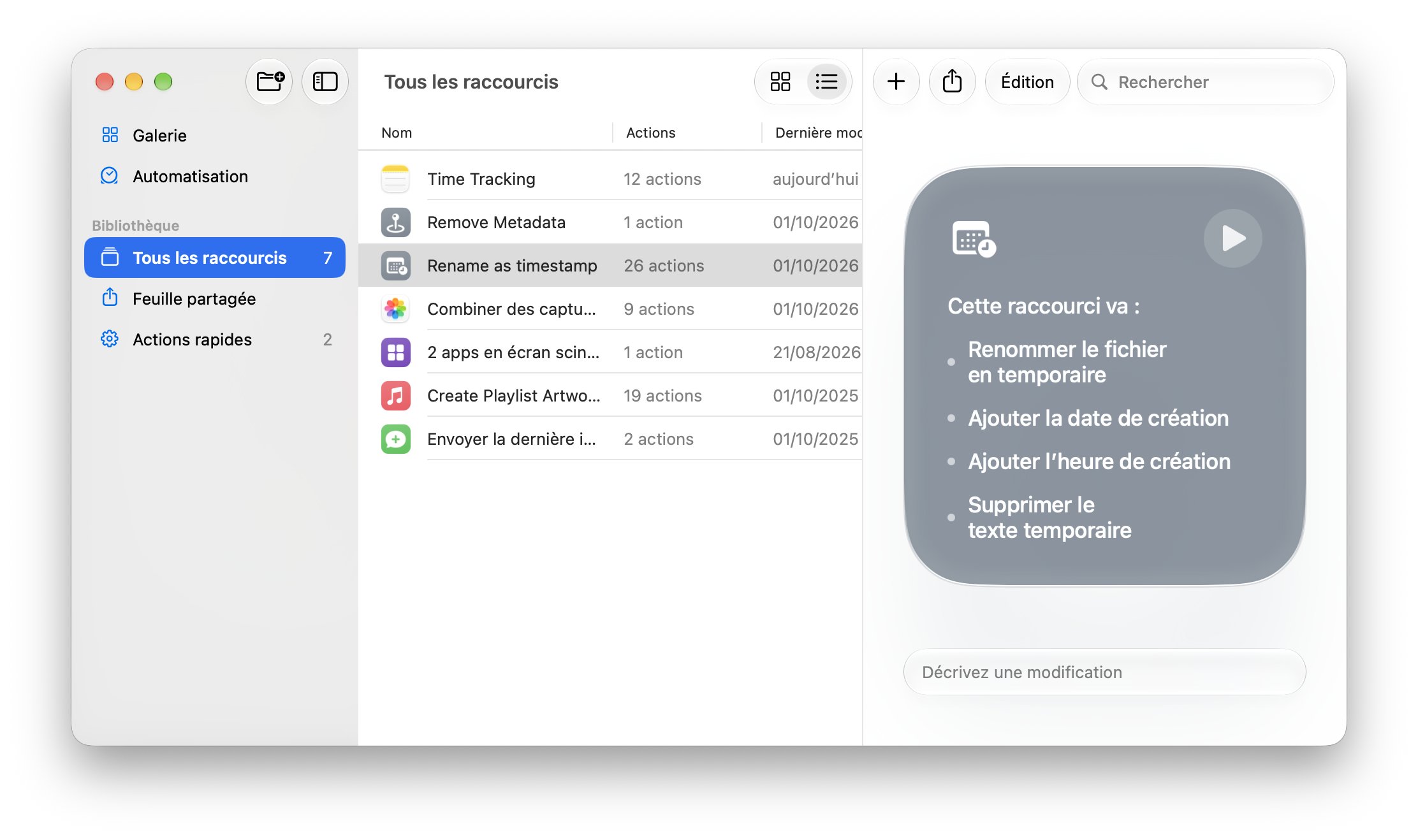
I’ve been using Automator for a long time now (like 20 years, really), and I started replacing some of my services and quick actions with Shortcuts. Thanksfully, it is possible to directly import exiting Automator workflows into Shortcuts, so that was not that painful. There’s still a lot work to do, though. #apple
Proofreading with Writing Tools: Great use of side by side diff windows with BBEdit. Effectively, I was really late to this one (writing tools have been around for a while now). #apple
Apple doesn’t seem too happy about agents. — Apple and a Hacker’s Future
I’m not either.