Latest micro-posts
You can also also view the full archives of micro-posts. Longer blog posts are available in the Articles section.

Org-mode features you may not know, by Bastien himself. #emacs
A great (re)read: A CEO’s Guide to Emacs.
For those who haven’t used Emacs, it’s something you’ll likely hate, but may love. It’s sort of a Rube Goldberg machine the size of a house that, at first glance, performs all the functions of a toaster. That hardly sounds like an endorsement, but the key phrase is “at first glance.” Once you grok Emacs, you realize that it’s a thermonuclear toaster that can also serve as the engine for… well, just about anything you want to do with text. When you think about how much your computing life revolves around text, this is a rather bold statement. Bold, but true.
When you think power-law, think skew: the vast majority of customers contribute negligible revenue, a small proportion of customers contribute almost all the revenue. — Beware the mean
If you are in a nostalgic mood, go read Installing NextStep OS (OpenStep) in VirtualBox, at least to enjoy the screenshots.
Although I’m quite happy with Biopython for processing (D|R)NA files, I’m interested to see if there’s something really interesting in the Julia ecosystem, e.g. BioSequences.jl.
TIL there’s something like a plain text database called GNU Recutils.
I've learned that Apple engineers have internal tools which allow them to delete macl xattr as well as to bypass other Catalina privacy and sandbox protections without rebooting and disabling SIP.
— Jeff Johnson (@lapcatsoftware) January 20, 2020
Inside Apple they don't suffer the same problems as external users and developers. https://t.co/UGcwVZ9XF4
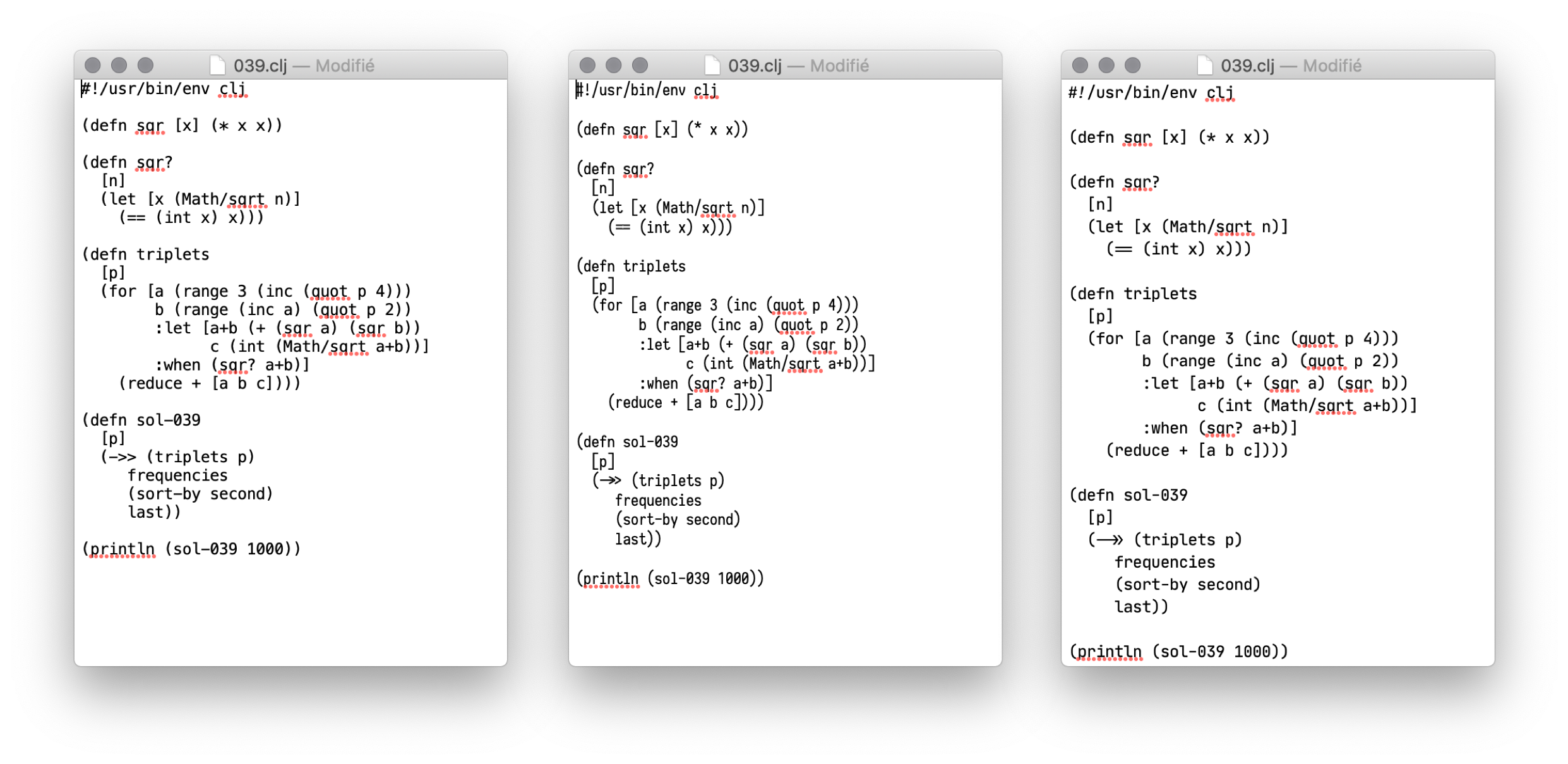
JetBrains Mono looks like a nice new monospace font, with support for ligature (like Fira Code). Yet, it is far less condensed than Inziu Iosevka, and after more than one year of using Iosevka in Emacs and iTerm I became quite used to it. Here it is, from left to right: Menlo, Iosevka, and JB Mono. (Click to enlarge)