Latest micro-posts
You can also also view the full archives of micro-posts. Longer blog posts are available in the Articles section.
Doom Emacs tweaks: Org Journal and Super Agenda. Nice post on BSAG website, as always. I personally don’t use Org agenda, although I keep a list of TODO items and web links in separate org files. I once started to keep a daily workbook, but I stopped after a few months. Maybe I should try again. #emacs
Doing Basic Ass Shit in Haskell: Nice resources on Haskell and functional programming. Each time I promise I will learn more Haskell than one-liner at the ghci prompt, but each time I find myself too lazy, as always. #haskell
Compared to when I first restarted this site using Hugo, the number of static files has quite significantly increased:
                   |  EN
+------------------+------+
  Pages            | 1548
  Paginator pages  |  190
  Non-page files   |    0
  Static files     |  689
  Processed images |    0
  Aliases          |   38
  Sitemaps         |    1
  Cleaned          |    0
Hot off the kitchen (yesterady’s evening and today’s lunch):
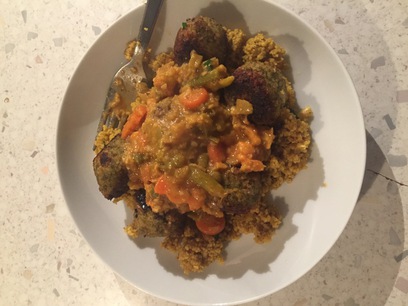

I don’t know any borders, and in each case two or three products from different continents were mixed.
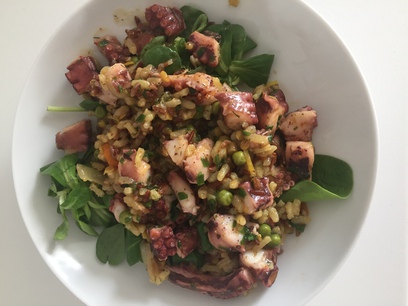
Happy meal, from some days ago.
Tonight I’ll probably end up watching the last episode of Morden i Sandhamn (Season 7). I’m not sure what I’m going to put on the list of things to look at next, but I’ll try to find something as entertaining as Swedish or Danish TV shows.
Since common-lisp-stat has been very quite the last years or so, I was very happy to find Gary Hollis’s CL data analysis library. Lisp still has a bright future ahead. #lisp
Ease of learning vs relearning, by John Cook. Nice points, as always. I have just some minor concerns with the last paragraphs where the author says that the tidyverse is great beacuse of its consistency. First, pending some minor annoyances with the naming convention of formal arguments in base R functions–and recommended packages–, which I always called R’s language idiosyncrasies, I do not find base R that much inconsistent. Second, I disagree with the idea that the tidyverse comes with that much conceptual integrity, for what I used to see. Most importantly, there are so many dedicated functions in, e.g., dplyr, that it goes against the principle of compositionality that we use to like in functional and scripting languages. Finally, what used to be available in a short number of packages, but especially base, is now scattered throughout several packages (forcats, glue, etc.), so that I have a hard time believing that newcomers could find their way as easily as they would with base R only. Anyway, that’s my 2¢, and it is nowhere a critic of Hadley Wickham’s account to the R ecosystem. #rstats