Latest micro-posts
You can also also view the full archives of micro-posts. Longer blog posts are available in the Articles section.
What a beautiful artistic work at the crossroads between dataviz and
infographics, by @janezhgw. #dataviz

Here is the fourth edition of Algorithms, by Sedgewick & Wayne, a definitive book to have after Knuth’s monumental work and the Cormen et al. (via @TechSparx)
Scientists rise up against statistical significance. Together with Moving to a World Beyond “p < 0.05”, it is probably time to rethink statistical significance and embrace the world of uncertainty instead. As Stephen Seen once said:
We can predict nothing with certainty but we can predict how uncertain our predictions will be, on average that is. Statistics is the science that tells us how.
An Introduction to Applied Bioinformatics: An interesting online textbook that I
found while browsing the scikit-bio Python package on Github. #python
Interesting to know: The wakefield R packages allows to quickly generate random
data sets. I learned about that while reading David Gohel’s Using R as a BI
tool. #rstats
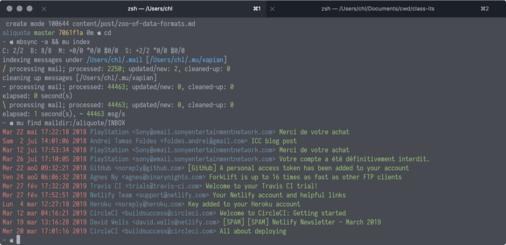
On the simplicity of working with a Terminal: processing 44K of mails in less than 2 seconds.
Too late to start re-reading Don Knuth’s excellent book on Mathematical Writing (PDF), but I will definitively do it in a few days.
What is Data Science after all? I never liked this term, and I consider myself as a statistician, or better a data craftsman, because I mostly spend my time dealing with data after all. Stephanie C. Hicks & Roger D. Peng wrote a nice article, Elements and Principles of Data Analysis, which I believe provides quite an honest account of DS-related stuff:
Data science is the science and design of (1) actively creating a question to inves- tigate a hypothesis with data, (2) connecting that question with the collection of appro- priate data and the application of appropriate methods, algorithms, computational tools or languages in a data analysis, and (3) communicating and making decisions based on new or already established knowledge derived from the data and data analysis.