CONTEXT once and for all
I’ve kept installing the latest MacTeX distribution on my MacBook for as long as I remember having a Mac. I never used MS Word (except for occasional proof-reading of scientific papers), and when it was absolutely necessary to produce a DOC (then a DOCX) document, I wrote everything in Pages and then exported it to the desired format. Working with MS format in Pages was (and is still) a pain because you always end up exporting the final version each time. Importing and exporting after each major revision has always felt like a pain in the ass. And working with BibTeX was never an option. Yes, we could use Endnote in principle, should we were willing to loose cross-references after exchanging the file with a colleague. I transferred my licence to a former colleague of mine. Anyway, I always wrote in $\LaTeX$ since my PhD, although I never really like the plethora of packages which need to be part of the whole document.1 I’m talking using the base classes like article or report, not more elaborated stuff like KOMA-Script, memoir & Co. Now I don’t even know what the state of the art is: what is the mandatory set of default packages to include, should we use lualatex only, who’s still using the dvi-ps-pdf toolchain, should lmodern be the default font now? I stopped following best practices and I spent years letting Pandoc do all the job of converting my Markdown document for me, although Markdown remains very limited in its basic form. But you know how it is – we’ve got a report to produce by tomorrow, we’re already running late, and we’re not 20 anymore, so we can’t spend hours pulling all-nighters trying to impress our colleagues.
I had a great time with Org, then plain $\TeX$, and now I remember that I’ve only been tied to $\LaTeX$ because of literate programming with R or Stata. I had my time with Sweave, knitr, now quarto. I also had good times with noweb and statweave. Remember the 2000s? The only format I’ve always felt comfortable with was CONTEXT, though. Sadly, I only spent a few years writing in CONTEXT. This was in 2008-2010, BibTeX support was already there, the simple-slides and filter modules written by Aditya Mahajan were already useable, CONTEXT felt closer to plain $\TeX$, and the documentation was already excellent. The design of this website was largely inspired by that of the PRAGMA Advanced Document Enginnering itself – check the Wayback machine if you like. But literate programming was the clear winner at that time. I had reports to produce every week or so, and knitr soon became the de facto typesetting system. I may have produced more than a thousand of such reports over a period of 10 years,2 and all of this was perfectly reproducible. I can still run some of those reports 10 years later. But that’s not the point.
$\LaTeX$ and Beamer. I can’t count the number of times I’ve seen the same slides being shown at conferences or internal meetings, all based on standard Beamer templates. Yes, there was an alternative, Metropolis (originally mtheme – the so-called modern $\LaTeX$ Beamer theme), and everyone started using that theme. How come nobody wrote their own template? I had to resort to foiltex or a stremlined version of Metropolis (now forked as Moloch) to feel like I have something to say about clear presentation and typography without all the hassle of configuring $\LaTeX$ options.
It’s appalling to see that the scientific publishing machine (think AMSTeX, arXiv, etc.) has imposed such a stranglehold on $\LaTeX$ that CONTEXT found no place within the system. Yet, it comes battery included. You will rarely need to include third-party modules, or even redefine default behavior, and typesetting math is far superior to that of LaTeX without specifying any options at all. Although I only used CONTEXT to process my slides and posters back in the days (around 50 in 10 years!), I now want to write everything using the new typesetting system.3
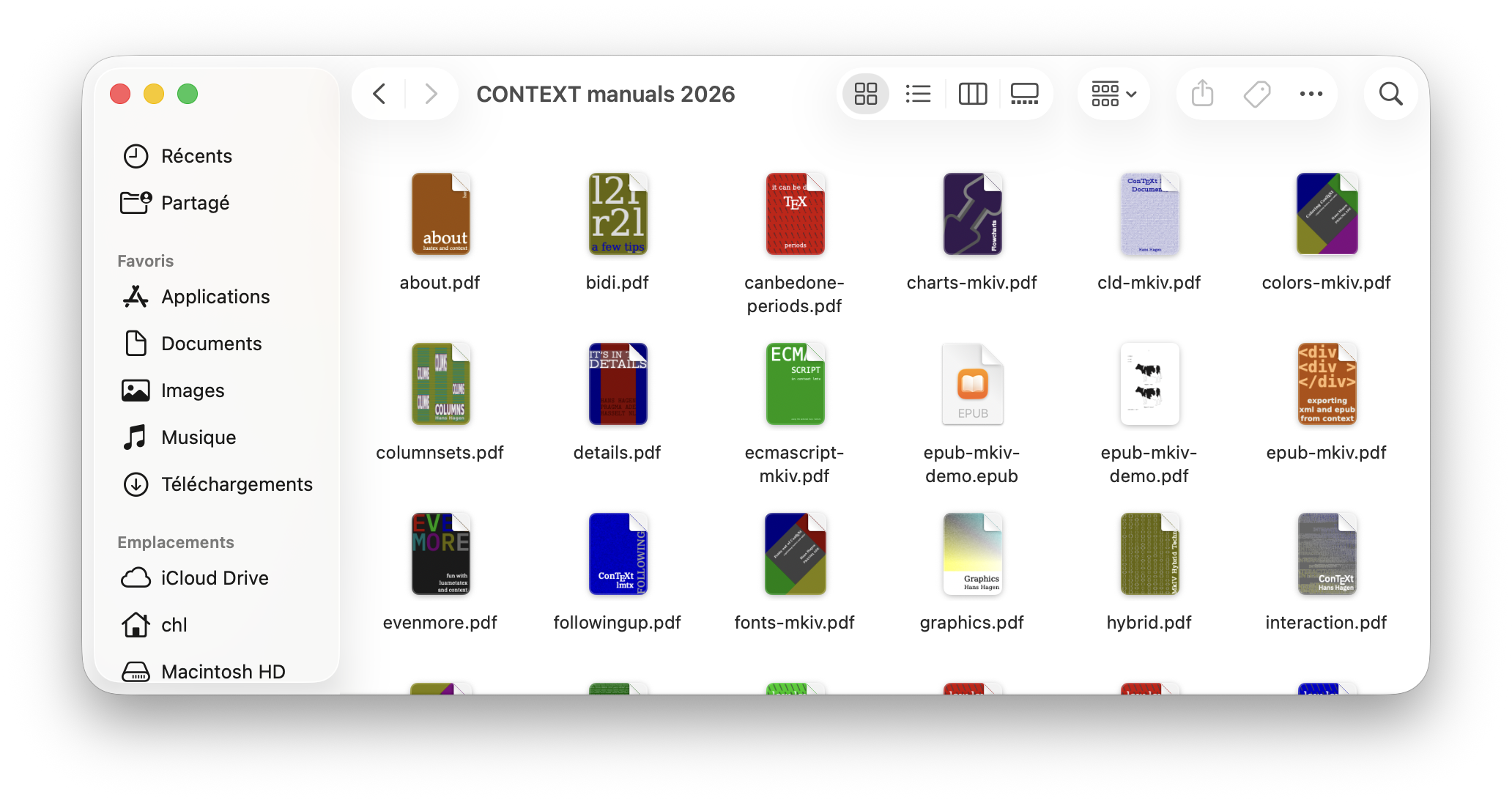
There are thousands of pages of documentation published on all aspects of CONTEXT. I do not even speak of journal entries and magazines available online. This is not texdoc or the not so short intro to $\LaTeX$. You get all the details, and all the templates from the talks given all around during the past 15 years.

Hans Hagen (PRAGMA ADE, Hasselt, NL)
The CGJ, MAPS and PRACJOURN templates are available in your TL distribution. The TeX-sidenotes package provides you with the Tufte handout for free as well. I devised a dozens of templates for TeXShop in less than an hour with all those resources. Hopefully I still have my old templates from the old me and I guess I’ll just need to adapt the environments a little.
I warmly recommend you give CONTEXT a try if you’re tired of $\LaTeX$ or MS
Word. Don’t be afraid, despite the large number of available commands, you can
get started with as few as a dozen of commands or so, so let’s
\starttext:
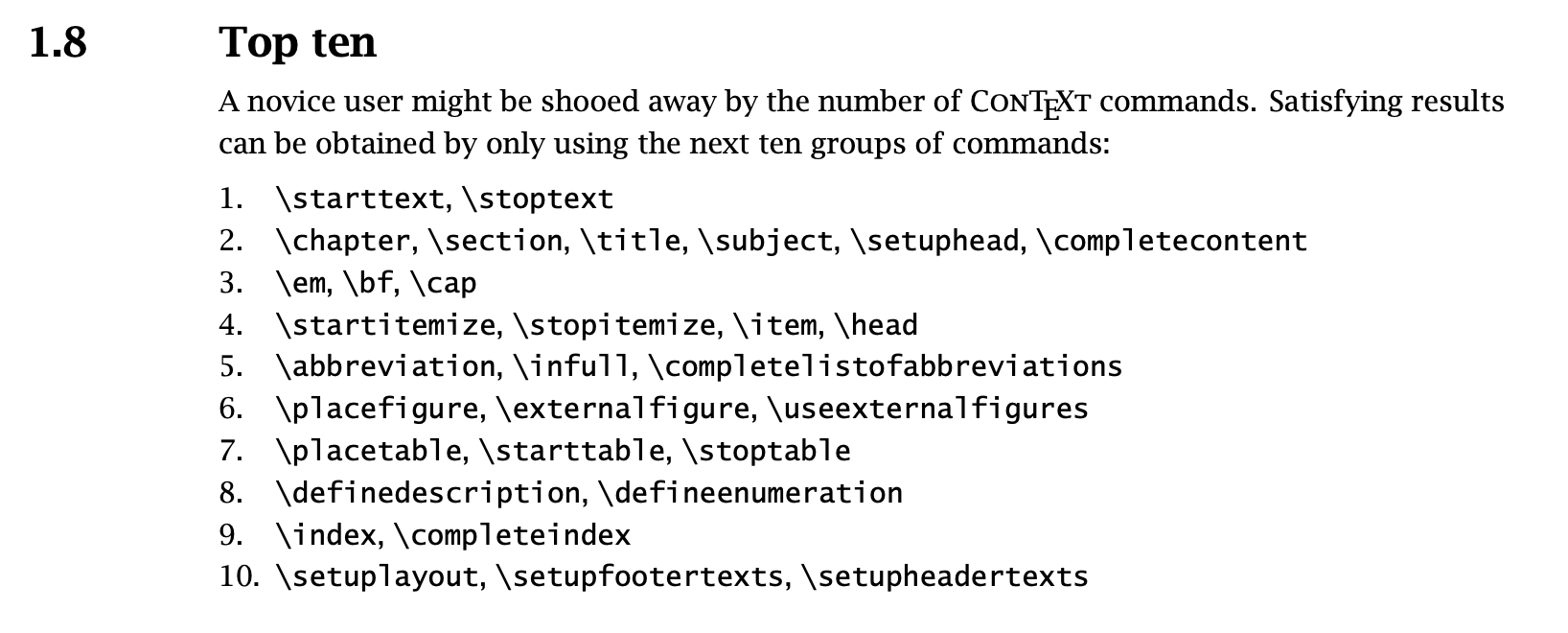
Source: CONTEXT: the manual (old version)
♪ The March Violets • Rich City
I don’t even speak of writing in French back in the days (circa 2000). ↩︎
And again, I don’t even speak of the number of times I was asked if I could produce an Excel table instead of my nicely formatted PDF report. ↩︎
Quoting Max Chernoff on TeX.SE: “The most recent version of ConTeXt is included in TeX Live, but TeX Live also includes the older versions. context
.tex will compile with the latest version (MkXL), context –luatex .tex will compile with the slightly older version (MkIV), and texexec .tex will compile with the oldest version (MkII).” ↩︎