Ctags for Scheme
It’s 2026 and I’m still using ctags. Who else? I mainly use (universal) ctags to browse definitions of symbol at point for Scheme and Lisp filetypes in Neovim since there’re no feature-complete LSP available for those languages.
I was browsing Ivan Raikov’s project array-morphisms and came across a call
to a procedure that I wanted to inspect. After generating a tag file as usual
(ctags -R .) and calling fzf-lua to grep the tag associated to the word under
the cursor, I realized that it gave no result at all. I checked the tag file,
and indeed the corresponding define statement did not meet any of my
expectations (it was found at random places as a function call, not a top-level
definition). I suspect this has to do with how Universal Ctags tries to match
the define keyword at the start of the line, which means that procedures
defined inside a module statement are not tagged properly.
I tried any-jump.vim which kinda works as expected (I only want go to definitions, not references, and I had to use ag instead of rg for whatever reasons), but that’s not satisfactory. I already have everything I need with fzf-lua as a picker.
This led me to try BBEdit regex playground to validate a regex for this use case, and it’s just kind of magic. You feed it up with some text, build your regex incrementally and see matches appear on the screen; you even get capture groups if any:
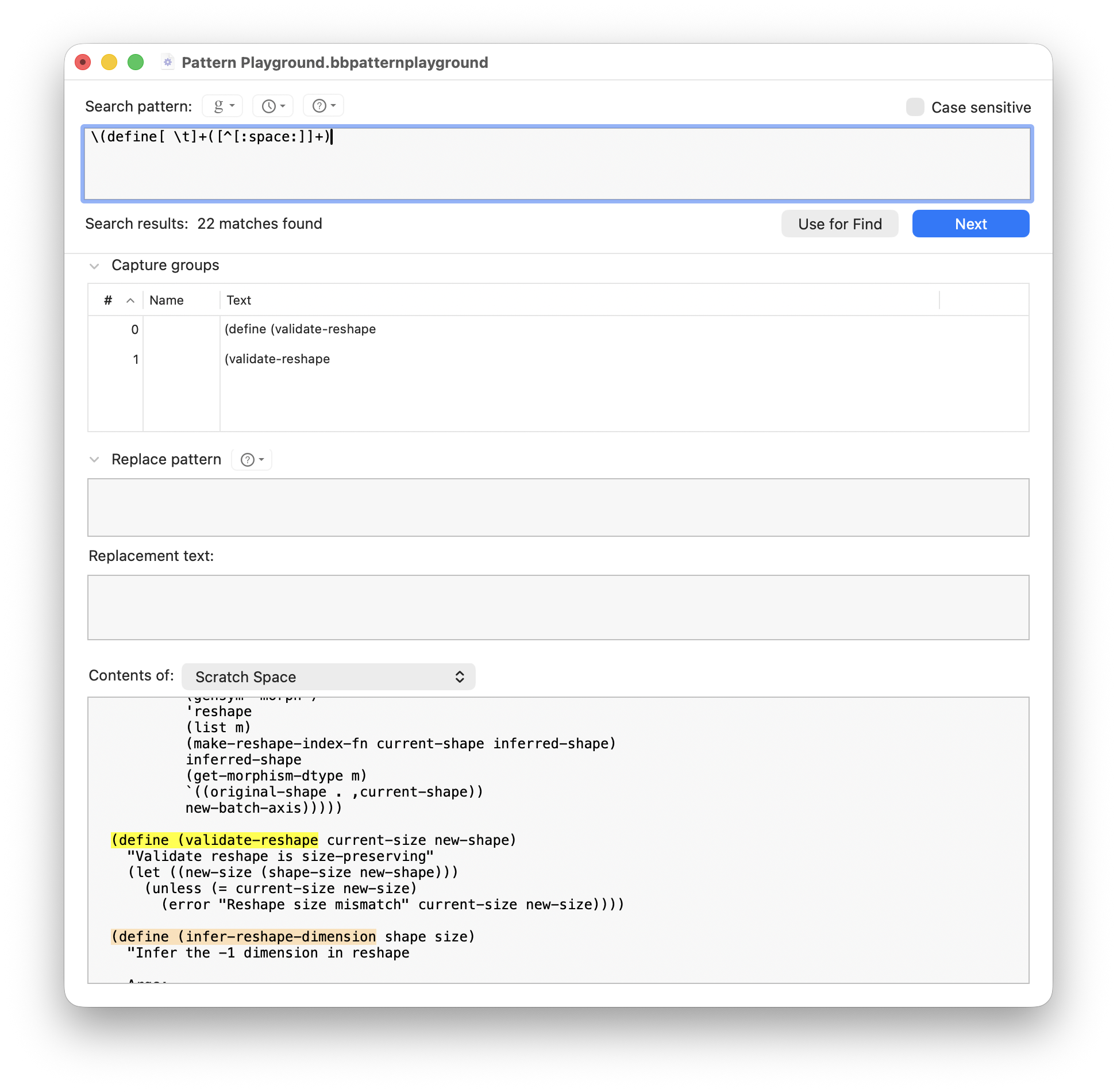
As can be seen in the above screenshot, my original idea was to capture the
procedure’s name right after the define keyword. Unfortunately, the capture
group includes the opening parenthesis. Add a non-capturing group and voilà:
\(define[ \t]+(?:\()([^[:space:]]+)
              ^^^^^^
This works in BBEdit, but not when calling ctags with this additional regex
pattern (defined in $HOME/.config/ctags/scheme.ctags), which left me puzzled
for a while until I realized that my original idea was indeed correct: I just
forgot to properly escape the opening parenthesis:
\(define[ \t]+\(([^[:space:]]+)
              ^^
What a silly mistake… However, this leaves me with some garbage, like globbing
things like (define branch-0 (morph-slice x '(0) '(16) 4)), which I would
qualify as false positives. I’m not sure why this happens since my regex looks
right, in particular there’s no greedy pattern after define that would explain
some non-whitespace garbage is captured along the way before the opening
parenthesis. That’s not a big deal since I can post-process the tag query with
fzf-lua filter, but I may have to check how ctags works for Scheme filetype.
At the moment, my scheme.ctags file reads:1
--regex-Scheme=/[ \t]*\(define[ \t]+\(([^[:space:]]+)/\1/f,function/
Besides, this led me to define the following keybindings in my
after/ftplugin/scheme.vim file:
nnoremap <buffer> <silent> gO :lua require("fzf-lua").tags()<cr>
nnoremap <buffer> <silent> gd :lua require("fzf-lua").tags_grep_cword()<cr>
nnoremap <buffer> <silent> grr :lua require("fzf-lua").grep_cword()<cr>
This mimics (more or less) what I already use for LSP stuff:
vim.keymap.set("n", "gd",
  "<cmd>lua require('fzf-lua').lsp_definitions({ jump1 = true, ignore_current_line=true })<cr>")
vim.keymap.set("n", "grr",
  "<cmd>lua require('fzf-lua').lsp_references({ ignore_current_line = true, includeDeclaration = false })<cr>")
if client and client.server_capabilities.documentSymbolProvider then
  vim.keymap.set("n", "gO", "<cmd>lua require('fzf-lua').lsp_document_symbols()<cr>")
elseif client and client.server_capabilities.workspaceSymbolProvider then
  vim.keymap.set("n", "gO", "<cmd>lua require('fzf-lua').lsp_workspace_symbols()<cr>")
end
Bonus reading for Ctags users: Surprising Ctags Behavior.
♪ Soul Asylum • Oxygen
I could probably use
\h+instead of the character class[ \t]+, and\S+instead of[^[:space:]]+. ↩︎