Iterated differences using Fold
After writing my last post, I started thinking about how to implement iterated differences as a fold. Christopher Olah once wrote a very nice blog post about recursion on lists in Haskell, and in particular on Folds.
Then I was reminded that Mathematica offers some nice recursive facilities too.
Since in the case of iterated differences we need to keep a trace of pairs of
elements and returns a list of n-1 elements, where n is the length of the
initial list, FoldList and NestList are good candidates.
The base configuration is as follows:
xs = {4, 9, 5}
Differences[xs]
This should return {5, -4}.
How about using a Fold in this case? Applied to a list, the pure function
Rest[#1] - Most[#1] & is all what we need: as with all listable operations,
given the list {1, 2, 3, 4, 5}, it will pair up and subtract the elements
returned by Rest, {2, 3, 4, 5}, and Most, {1, 2, 3, 4}, namely
{2-1, 3-2, 4-3, 5-4}.1 Using ‘Part’ syntax (#1[[2 ;;]] - #1[[1 ;; -2]] &)
would be far less readable, IMHO.
So, FoldList[Rest[#1] - Most[#1] &, xs, Range[1]] is what we are after. We
provides Range[•] as the third argument since FoldList expect a listable
item at this place, and it will simply serve as a counter for the pure function.
As an alternative, we may consider using NestList which doesn’t require an
auxiliary list:
FoldList[Rest[#1] - Most[#1] &, xs, Range[1]]
NestList[Rest[#1] - Most[#1] &, xs, 1]
NestList just keeps on applying a function to whatever result it got before. FoldList does the same, except that it also “folds in” a new element each time. — More about Pure Functions
In our application with FoldList we’re just ignoring the second argument
(#2). There’s an example of a cumulative sum in the manual cited above, which
does exactly the opposite: FoldList[#1 + #2 &, 0, {1, 1, 1, 2, 0, 0}] (which
can further be simplified to FoldList[Plus, 0, {1, 1, 1, 2, 0, 0}]).
Note that folding with Plus on the list of differences and starting with the
first element as the initial value simply reverts what Differences did:
FoldList[Plus, First[xs], Differences[xs]]
A few extra touches to enhance the presentation of the results:
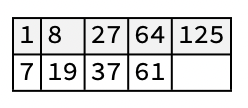
xs = {1, 8, 27, 64, 125};
values = FoldList[Rest[#1] - Most[#1] &, xs, Range[1]];
Grid[values, Alignment -> Left, Frame -> All, Background -> {None, {Lighter[Gray, 0.9]}}]
♪ My Life With The Thrill Kill Kult • Sexplosion!
Besides Part, the Wolfram language offers intuitive function to select member of a list:
First,LastandRestas in Racket, but alsoMostandDrop,Take; but see the tech note on working with lists. ↩︎