Iterated differences in Lisp
This is a following post to yesterday’s adventures with Folding in Mathematica. Today I’ll be using Common Lisp, listening to yet another album by My Life With The Thrill Kill Kult.
My original idea, which I wrote while browsing Mathematica’s documentation on
Fold was to use CL equivalent (reduce) with an auxiliary list keeping track of
the last seen item and the running differences:1
(defun diff-one (xs)
  (if (null xs)
      nil
      (reverse
       (cdr
        (reduce (lambda (acc curr)
                  (let ((prev (car acc))
                        (diffs (cdr acc)))
                    (cons curr (cons (- curr prev) diffs))))
                (cdr xs)
                :initial-value (cons (car xs) nil))))))
This is more verbose than Mathematica code, of course. We can make it less so,
though. Should we were cheating, we would rely on the omnipotent loop macro:
(defun diff-two (xs)
  (loop for (i j) on xs
        while j
        collect (- j i)))
A purely recursive solution using the when macro would also work in this case:
(defun diff-three (xs)
  (when (cdr xs)
    (cons (- (cadr xs) (car xs))
          (diff-three (cdr xs)))))
My preferred solution, which I have had for years in a stat project which never
saw the light of day, like so many others, remains: shift the original list
leftwise, and then compute the difference between each pair of item from both
list; mapcar will stop once the shortest list has been read to its end. Here’s
the one-liner:
(defun diff-four (xs)
  (mapcar #'- (cdr xs) xs))
How about timing?
(defparameter *values* (loop repeat 200 collect (random 30)))
(time (diff-one *values*))    ;; 0.000006 seconds of total run time
(time (diff-two *values*))    ;; 0.000004 seconds of total run time
(time (diff-three *values*))  ;; 0.000004 seconds of total run time
(time (diff-four *values*))   ;; 0.000006 seconds of total run time
The last solution is more or less how this routine is implemented in the
Serapeum package (deltas).
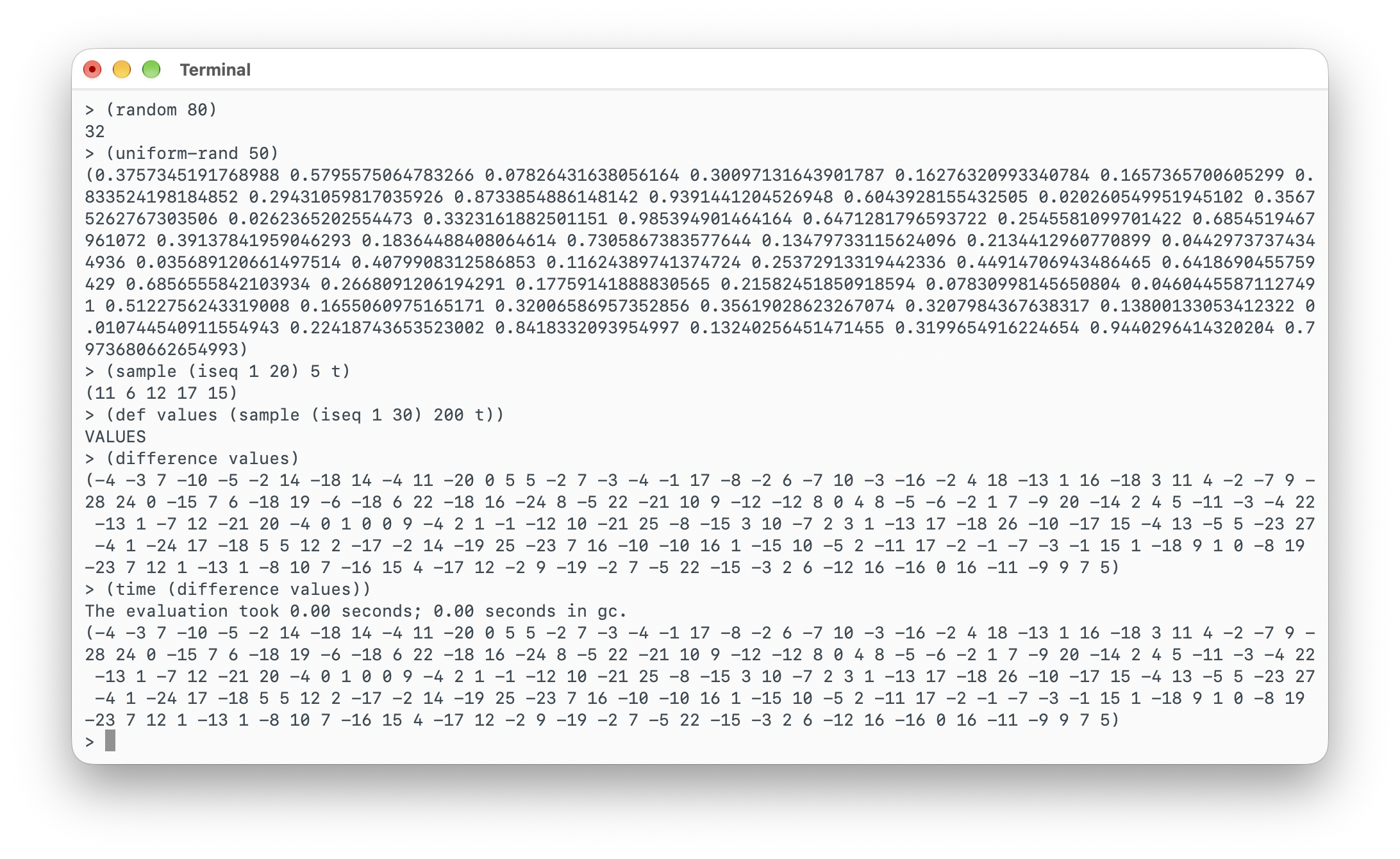
The venerable XLispStat has it too:
Sidenote
As for statistical applications, the mean of the squared successive differences provides an estimate of process variation but it can also be used to assess the randomness of chronologically ordered observations (e.g. time series data or residuals from a regression model) by comparing its estimate with the variance of the whole series – this is the basis of von Neumann ratio test, and the Durbin-Watson tests statistic for first-order serial correlation in residuals. The Bartels rank test is the rank version of von Neumann’s non parametric test and it might be used to test the serial correlation or trend in an ordered sample. A related test for randomness on binary events is the Run test.
♪ My Life With The Thrill Kill Kult • Leathersex
An equivalent version with
nreverseis:↩︎(defun diff (xs) (if (null xs) nil (let ((init (cons (car xs) nil))) (nreverse (cdr (reduce (lambda (acc curr) (let ((prev (car acc)) (diffs (cdr acc))) (cons curr (cons (- curr prev) diffs)))) (cdr xs) :initial-value init))))))